


 All products
 Checkout
 Distribution & Marketing
 Website builder
 WebStore
 Tax management & compliance
 Analytical tools
 Risk management system
 Mobile SDK
 Checkout Page Designer
 All industries
 Videogames
 Software
 Digital goods
 Online education
 User support
 Developer Support
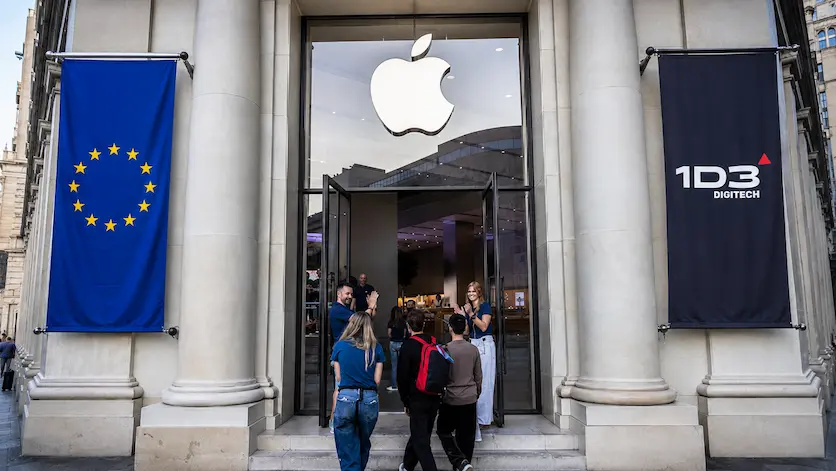
Apple is changing how developers can monetize apps in the European Union. Apple EU App Store fees will update on October 1st 2026, developers will be able to choose between Apple In-App Purchase, alternative payments, external web checkout and alternative app distribution.
For developers, the biggest change is that the different payment routes now come with very different Apple commissions.
| Payment model | Standard Apple commission |
|---|---|
|
Apple In-App Purchase | 26% |
|
Alternative payment inside the app | 20% |
|
Link to external web checkout | 15% |
|
Alternative app distribution | 5% |
Apple is also replacing its previous per-install Core Technology Fee with a 5% Core Technology Commission for digital transactions in apps distributed outside the App Store.
Reduced rates may apply to some developers, programs and subscriptions, so the exact numbers can differ.
Developers can now combine Apple IAP and alternative payments
One of the most important changes is that developers can offer Apple IAP together with alternative payment options.
For example, an app can keep Apple IAP while also offering a link to a web checkout. This gives developers more control over how users pay.
There is one important limitation: Apple says developers generally need to keep their chosen payment configuration for 12 months. That means the decision should be made carefully.
Where 1D3 fits
Using payments outside Apple IAP means developers need more than a payment button. They also need to handle areas such as:
- payments;
- VAT and other taxes;
- fraud and chargebacks;
- refunds;
- compliance;
- customer support.
1D3 operates as a Merchant of Record and handles this commerce infrastructure. Our fee is just 3% + actual processing costs. Processing costs depend on the payment method, so they should be calculated separately for each business.
Option 1: Alternative payments inside the app
If a developer uses an alternative payment method inside an App Store app, Apple's standard commission is 20%.
With 1D3, the structure is:
- 20% Apple + 3% 1D3 + actual processing costs
Compared with Apple's standard 26% IAP commission, the difference is relatively small. For many developers, this option may be more useful for gaining payment flexibility and control rather than purely reducing costs.
Option 2: Link to a web checkout
This is where the economics become more interesting. If an App Store app sends the user to an external checkout, Apple's standard commission is 15%.
With 1D3:
- 15% Apple + 3% 1D3 + actual processing costs
The difference compared with Apple's 26% IAP commission is much more significant. Specifically for high-volume developers, this can have a meaningful impact on margins. But lower fees do not automatically mean more revenue. If too many users leave the purchase flow when they are redirected to the web, the conversion loss can cancel out part of the savings. That is why developers should compare net revenue, not only commission rates. A simple way to think about it is:
- Net revenue = conversion × transaction value × retained revenue
A strong external checkout can improve the economics but poor checkout can do the opposite.
Option 3: Alternative app stores or direct website installation
Developers in the EU can also distribute their apps outside Apple’s App Store.
There are two main ways to do this:
- through another app store, such as the Epic Games Store (EGS), AltStore PAL or Aptoide;
- directly from the developer’s own website.
Direct website installation is similar in concept to downloading an APK on Android, but Apple still controls part of the process. The developer must meet Apple’s requirements, and the app must pass Apple’s Notarization checks before users can install it.
For apps distributed this way, Apple’s commission on digital transactions is 5%.
With 1D3:
- 5% Apple + 3% 1D3 + actual processing costs
This is the lowest Apple commission of the available options, but there is an important trade-off: the developer is no longer relying on the App Store for distribution. That means developers need to think about how users will discover, trust and install the app.
For a large game publisher with a strong brand and an existing audience, distributing through a third-party store or directly from its own website can be an interesting option. For smaller developers that depend heavily on App Store discovery, it may be less attractive.
Hybrid payments - the most practical approach
Developers do not necessarily need to replace Apple IAP completely. A publisher could keep Apple IAP for users who prefer Apple's native checkout while offering an external option to other customers. This can be particularly useful for mobile games.
A casual player making a small purchase may prefer Apple IAP. A highly engaged customer may be more willing to use a web checkout, especially if it offers different bundles, payment methods or account-based purchases. The goal is not to force every customer through the same payment route. It is to use the right payment option for the right customer.
Why this matters for mobile games
Mobile games often generate recurring revenue from:
- virtual currency;
- battle passes;
- subscriptions;
- cosmetic items;
- bundles;
- upgrades.
At scale, even a small change in transaction costs matters, every percentage point can generate significant additional revenue especially in the long term. That makes payment architecture a direct P&L question for large publishers.
What developers should compare
Before moving to Apple's new EU terms, developers should model four scenarios:
| Apple IAP 26% standard Apple commission. | Alternative payment inside the app 20% Apple + 3% 1D3 + actual processing costs. |
| External web checkout 15% Apple + 3% 1D3 + actual processing costs. | Alternative distribution 5% Apple + 3% 1D3 + actual processing costs. |
The right option depends on more than fees. Developers should also consider conversion, payment methods, refunds, fraud, taxes, operational work and the value of App Store distribution.
The main takeaway
Apple's EU changes give developers much more flexibility over how they monetize iOS users.
The biggest opportunity is not simply finding the lowest commission. It is finding the combination of distribution, checkout and payment infrastructure that produces the highest net revenue For many large developers, the 15% external checkout model is likely to be the most interesting starting point because it reduces Apple's commission significantly while keeping the app inside the App Store. For others, keeping Apple IAP or exploring alternative distribution may make more sense.
From 1 October 2026, payment architecture becomes something developers should actively model rather than accept as a fixed part of App Store distribution.