


 All products
 Checkout
 Distribution & Marketing
 Website builder
 WebStore
 Tax management & compliance
 Analytical tools
 Risk management system
 Mobile SDK
 Checkout Page Designer
 All industries
 Videogames
 Software
 Digital goods
 Online education
 User support
 Developer Support
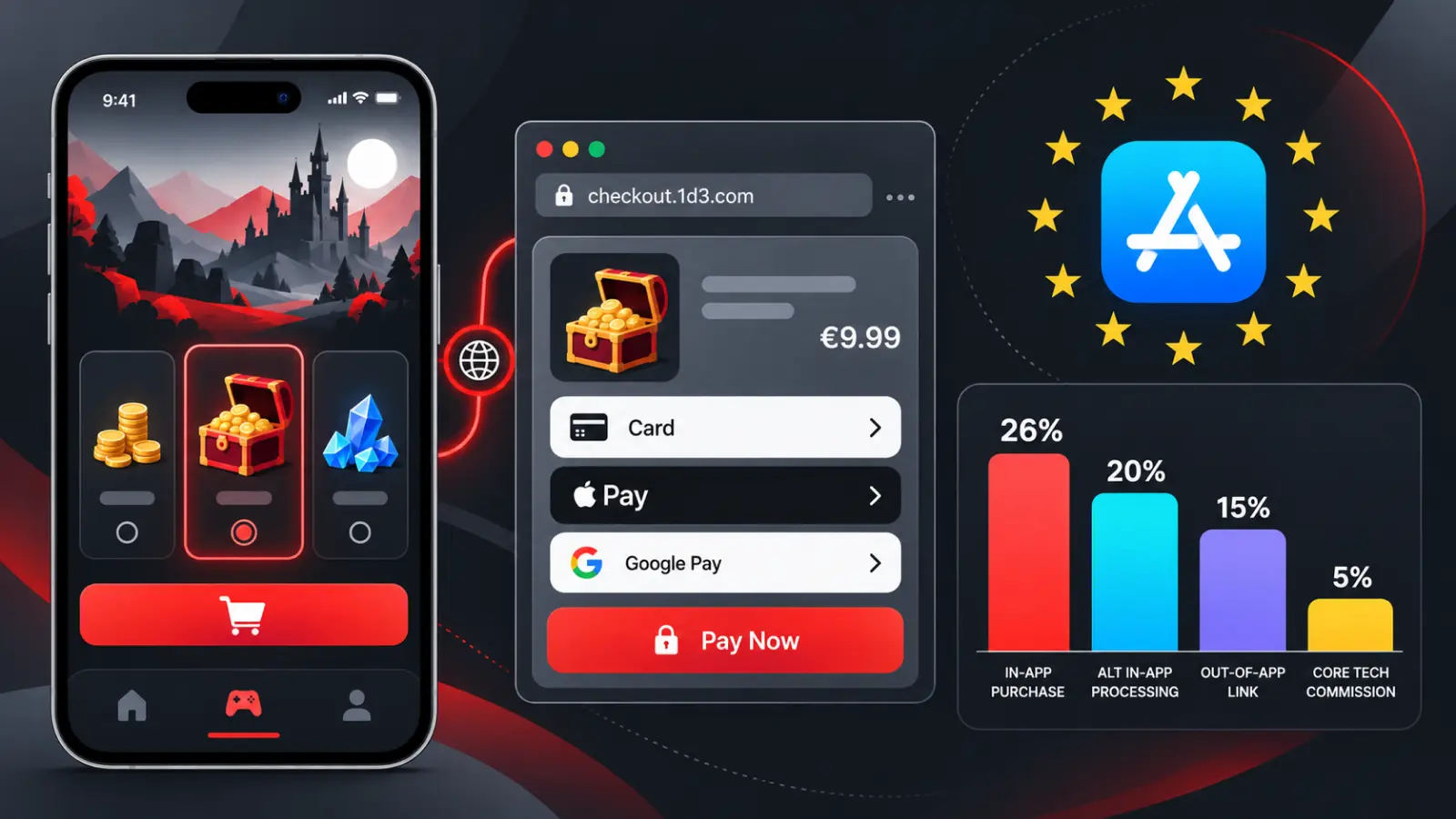
Apple's new EU rules fundamentally change how mobile game and app developers can approach direct-to-consumer monetization.
Starting October 1st, 2026, developers distributing apps through the EU App Store can offer Apple In-App Purchase and alternative payment options alongside each other. That includes directing users from an iOS app to a D2C webstore. Apple has also introduced a new commission structure, including a 15% commission for qualifying out-of-app purchases initiated through an actionable link.
For publishers, this creates a meaningful opportunity. But it also creates a question we hear repeatedly in discussions about D2C:
“If we move players from Apple IAP to our webstore, will Apple reduce our visibility in the App Store?”
Leading mobile developers and publishers are already proving that Apple IAP and D2C webstores can work successfully in parallel. The strongest implementations do not replace Apple IAP entirely; they add a direct channel that gives players more choice while improving payment economics.
- Keep Apple IAP.
- Add the webstore.
- Let players choose.
- Optimize the mix.
For iOS developers, D2C should be an optimization layer on top of an already successful App Store business – not a sudden replacement for it.
A Webstore purchase is not an Apple IAP
Terminology matters. If a player buys virtual currency, a battle pass, a subscription, an item bundle, or other digital content through your website, that transaction is an external purchase, not an Apple in-App Purchase.
The content can still be available inside the iOS game or app.Under Apple's new EU terms, an App Store application can offer Apple IAP and an external purchase option at the same time. Apple requires Apple IAP to be displayed at least as prominently as alternative payment options when they are presented together, but developers may offer different pricing or benefits through the alternative option.
This makes a hybrid D2C model possible. And for most developers, hybrid is where we believe the experiment should begin.
The top questions developers ask about iOS D2C:
1. Will Apple lower our app store ranking if our IAP revenue falls?
Mobile publishers are already running Apple IAP and D2C webstores in parallel.
- Supercell operates the Supercell Store for games such as Clash of Clans while continuing to offer Apple IAP. Clash of Clans still maintains a 4.8 App Store rating with millions of ratings.
- Scopely does the same with MONOPOLY GO!: the game has an official web shop and still generates massive Apple IAP revenue. In 2025, Sensor Tower estimated more than $6 billion in lifetime IAP revenue, excluding D2C revenue.
- Miniclip reported that its Knighthood web shop moved around 10% of paying users to web while Apple IAP remained available.
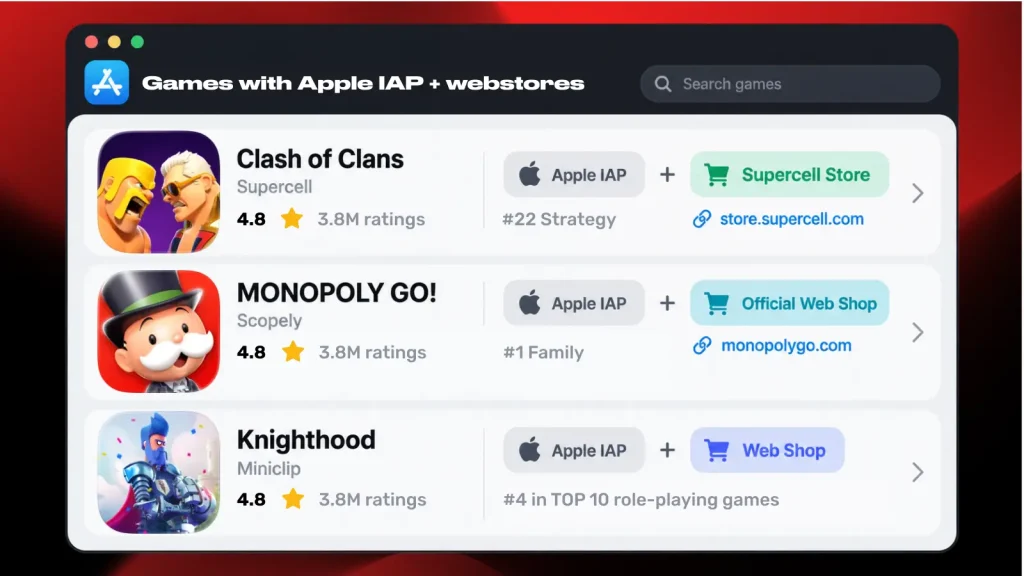
The pattern is clear: successful publishers do not replace Apple IAP completely. They add D2C as a second channel. Keep Apple IAP available, move part of the payer base to web, and monitor ratings, retention, conversion and net LTV. The goal is not to eliminate Apple IAP. It is to move the right share of transactions to D2C while keeping the App Store business healthy.
2. Should we replace Apple IAP with a webstore?
Usually, no. For an existing game, switching 100% of users to an external checkout creates unnecessary risk. Apple IAP has an enormous UX advantage: users already understand it, their payment credentials are available, and purchasing can be completed with very little friction.
A webstore introduces another step. Even if the transaction economics are better, losing too many users between the game and checkout can eliminate that advantage. The better starting architecture is:
Apple IAP + D2C webstore in parallel. This is now explicitly supported under Apple's updated EU rules.
The player who values Apple's native checkout can continue using it. The player who is comfortable purchasing directly can choose your webstore. And the publisher can measure which users, products and offers are best suited to D2C.
This is particularly important for games with an established paying population. There is little reason to force a high-value player away from a payment flow that already works. Instead, make D2C incremental.
The strategic objective should not be:
- maximize the percentage of revenue leaving Apple IAP.
It should be:
- maximize total net LTV.
Those are very different objectives.
3. Can a webstore damage ratings or conversion?
Yes, but only if the UX is bad. This is probably the most important practical risk in a D2C implementation.
Apple requires apps using actionable external purchase links to display a system-provided disclosure informing the user that the transaction will take place outside Apple's commerce system. Apple also adds information about external purchases to the app's App Store product experience.
That means developers should assume some users will hesitate. The solution is not to remove Apple IAP. It is to make the alternative journey extremely good.
The transition between game and webstore should feel like part of the same product. Authentication should be seamless. The player should immediately understand what they are buying. Pricing should be clear. Checkout should be localised. The purchase should appear in the game immediately after payment.
- Do not make players repeatedly log in.
- Do not send them to a generic e-commerce page.
- Do not make the external option look suspicious.
- Do not create a five-step checkout to save a few percentage points in commission.
- And most importantly, do not aggressively interrupt gameplay with messages pushing users toward the webstore.
Poor payment UX can eventually become an App Store problem even if Apple itself does nothing.
- An annoyed player may leave a poor review.
- A confusing purchase flow can reduce retention.
- Customer-service problems can damage ratings.
And lower ratings can affect both download conversion and discoverability. Apple explicitly says ratings and reviews can improve discoverability and encourage downloads.
So the relevant risk is primarily indirect:
bad D2C UX → unhappy players → worse reviews/conversion/retention → weaker App Store performance.
That is controllable. Apple also states that it will not handle refunds, subscription management and other customer-support issues for external purchases. Those responsibilities move outside Apple's commerce system.
For a developer, this is one reason to use a Merchant of Record rather than simply attaching a basic card processor to a webpage.
4. How much revenue can we actually gain with Apple IAP + a Webstore?
This is where the hybrid model becomes interesting.
| Apple IAP | Apple + external checkout |
|---|---|
| 26% | Apple commission: 15% 1D3 Fee: 3% Processing costs: 2%* |
| Total fee: 26% | Total fee: 20% |
Lets compare Apple IAPs with 1D3 + hybrid model.
The difference is 6 percentage points on every transaction successfully moved to the webstore. For publishers, this becomes substantial.
EXAMPLE: €100 million of annual eligible EU GMV
| Share successfully routed through D2C webstore | Webstore GMV | Blended payment/platform cost | Approx. annual saving vs 100% Apple IAP |
|---|---|---|---|
0% | €0 | 26.00% | €0 |
10% | €10m | 25.42% | €580,000 |
25% | €25m | 24.55% | €1.45m |
50% | €50m | 23.10% | €2.90m |
75% | €75m | 21.65% | €4.35m |
That is the point. A publisher does not need to move all revenue off Apple to create meaningful economics. A €100 million business moving only 25% of eligible GMV to the webstore could theoretically improve annual contribution by approximately €1.45 million before accounting for taxes, refunds, FX, differences in payment mix and changes in conversion. At €50 million GMV, the same 25% migration represents approximately €725,000. The economics scale linearly.
The More Important Number: Your Break-Even Conversion Rate
The commission difference creates another useful way to think about D2C. From a hypothetical €100 transaction:
- Apple IAP at 26% leaves approximately: €74.00
- A 1D3-powered external checkout using an EU card, at an illustrative combined cost of 20.2%, leaves approximately: €79.80
That means the webstore does not necessarily need to retain exactly the same gross payment conversion as Apple IAP to produce the same net revenue.
Under these simplified assumptions, the external channel would break even at roughly:
€74 / €79.80 = 92.7%
In other words, the publisher could theoretically tolerate roughly a 7.3% reduction in completed gross purchase value on traffic moved from IAP to web and still generate approximately the same net proceeds.This is not a universal benchmark. VAT, transaction mix, refunds, pricing, payment methods and player behavior can materially change the calculation. But it illustrates why developers should test D2C rather than reject it because web checkout may convert somewhat lower than Apple IAP.
You do not necessarily need equal conversion. You need higher net revenue per monetization opportunity.
D2C can also fund better offers
Apple explicitly says alternative payment options may include different prices and benefits. That allows publishers to split the economic benefit between themselves and their players.
For example, rather than keeping the entire 6% theoretical saving, a publisher or developer could use part of it to provide additional virtual currency, loyalty benefits or a different price through its webstore.
Using the same simplified economics, even a webstore purchase priced at €95 instead of €100 would generate: €95 × 80% = approximately €76.00
That remains above the approximately €74 retained from a €100 Apple IAP transaction under a 26% commission. In other words, D2C creates room to experiment with both: higher publisher margin and higher player value. The correct balance depends on the game.
5. How do we experiment without putting the core App Store business at risk?
Do not treat D2C as a migration project. Treat it as a monetization experiment. You should launch the webstore while keeping Apple IAP available, then measure performance by cohort, geography, product type and player segment.
Apple's current EU rules actually reinforce this approach. If developers offer an alternative payment option alongside Apple IAP, Apple IAP must be available simultaneously and at least as prominent in the relevant purchase interface.
There is also an important contractual consideration: once a developer selects its combination of Apple IAP, alternative in-app payments and actionable out-of-app offers, Apple requires that selection to be maintained across EU storefronts for 12 months.
That means the architecture should be planned carefully. But keeping both IAP and web checkout means you can continue optimizing the commercial mix inside that architecture.
The key metrics are not simply "IAP revenue" and "webstore revenue." A serious D2C experiment should measure:
App Store impressions → product-page conversion → downloads → activation → retention → payer conversion → checkout conversion → ARPPU → refund rate → support rate → net revenue → LTV.
App Store Connect already provides acquisition, engagement, retention and monetization analytics that developers can use to monitor many of these guardrails. If App Store downloads remain stable, ratings remain stable, retention remains stable and total net revenue increases, then a decline in the percentage of payments going through Apple IAP should not by itself be treated as a negative outcome. It may simply mean that the payment mix is becoming more efficient.
Don't optimize for "Webstore share"
One of the easiest mistakes in D2C is to turn webstore penetration into a vanity metric. Imagine two publishers:
- Publisher A moves 60% of transactions to web but damages purchase conversion badly.
- Publisher B moves only 25% to web but targets the right users, preserves conversion and increases total net LTV.
Publisher B has the better D2C strategy. The goal is not to maximize external payments. The goal is to find the optimal mix between native Apple IAP and direct commerce.
This is particularly important for whales and high-value repeat purchasers. A first-time €4.99 payer may prefer Apple IAP. A highly engaged player who purchases €500 per month may be much more willing to use a branded webstore, particularly if the webstore provides additional value. Those users do not have to follow the same payment journey.
D2C is becoming a normal part of mobile game monetization
Webstores are no longer limited to a handful of experimental publishers. Unity reported in July 2026 that D2C revenue among top mobile titles continued to expand and that webstores had become common among leading Strategy, Action and social-casino games.
Unity has subsequently expanded its own IAP tooling to support D2C providers and webstores alongside native store purchasing. The direction of the market is therefore increasingly clear.
The strategic question for a publisher and developer is no longer:
"Should we abandon Apple IAP?"
It is:
"What percentage of our commerce should remain in Apple IAP, and what percentage can generate higher net LTV through D2C?"
That is a much safer question. And a much more valuable one.
Where 1D3 fits into the hybrid model
Building the webstore itself is not the difficult part. The difficult part is running commerce at scale.
A developer needs payment processing, payment-method coverage, fraud management, refunds, disputes, transaction reconciliation, tax operations, subscription logic and reliable delivery of purchases back into the player's account.
Apple also requires external-purchase transactions to be reported under its applicable external-purchase framework.
This is why the Merchant of Record model is relevant. With 1D3, the commercial model is straightforward:
3% service fee + actual payment processing costs.
For a standard-rate developer using Apple's EU link-out model, that produces illustrative total transaction economics of approximately: 20.2% with EU cards v.s. 26% with Apple IAP.
More importantly, D2C becomes a channel the developer can operate alongside, rather than instead of, Apple IAP. That greatly reduces the strategic risk of testing it.
The safest D2C strategy is hybrid
Developers should not interpret Apple's new rules as a reason to shut down Apple IAP. Apple IAP remains an excellent payment experience for many users. The opportunity is to stop treating it as the only payment experience.
- Keep Apple IAP available.
- Launch a high-quality D2C webstore.
- Make the transition between the game and checkout seamless.
- Give users a real reason to use direct commerce.
- Measure App Store conversion and ratings as guardrails.
- Measure net LTV as the primary business outcome.
- Then expand D2C only when the data supports it.
Successful publishers already operate Apple IAP and D2C webstores in parallel at scale, showing that shifting part of the payment volume to web can coexist with a strong App Store presence. Apple's published search documentation emphasizes relevance, downloads, ratings, reviews and other user behavior instead.
At the same time, developers should not pretend external commerce is risk-free.
- Poor UX can hurt conversion.
- Poor customer support can hurt reviews.
- Incorrect implementation can create compliance problems.
Those risks are manageable precisely because publishers no longer have to make an all-or-nothing decision.
Apple IAP and D2C can now work together.
For mobile game developers, that makes 2026 an unusually good time to test what the optimal payment mix actually looks like.
Examples are illustrative and based on the stated Apple fees, 1D3 pricing and assumed payment-processing costs. Actual results depend on payment mix, conversion and applicable Apple terms.