

 All products
 Checkout
 Distribution & Marketing
 Website builder
 WebStore
 Tax management & compliance
 Analytical tools
 Risk management system
 Mobile SDK
 Checkout Page Designer
 All industries
 Videogames
 Software
 Digital goods
 Online education
 User support
 Developer Support


In spring 2025, a federal court ruling in Epic Games v. Apple forced Apple to let US apps send users to external checkouts on iOS. Today, more than a year later, the question for developers is no longer whether it's allowed, but whether it works and who is already benefiting.
When Apple updated its App Review Guidelines on May 1st, 2025, many iOS developers reacted with a mix of excitement and suspicion. On paper, US apps could finally link users to their own webstores. In practice, plenty of teams decided to wait. Would Apple find another way to push back? Could apps that link out face a shadow ban in the App Store? And what if the courts reversed everything within months?
More than a year later, there's enough success cases to answer most of those questions. Spotify, Fortnite, Patreon, Amazon Kindle and 37signals' HEY all send US iPhone users to their own checkouts today, and all of them are still doing well on the App Store.
As D2C adoption grows, 1D3 Managing Director Dmitry Storozhilov breaks down what developers can do today, which risks still matter, and how to approach external checkout without hurting App Store performance.
Q: The rules changed more than a year ago. What do they actually allow today?
A: The core point is simple, but it's worth explaining because we still meet developers who aren't sure. After the court's decision, Apple updated its App Review Guidelines on May 1, 2025. For apps on the US App Store, the rules are now much simpler. You can add a button or link that sends users to an external checkout, and you do not need Apple’s External Purchase Link Entitlement to do it (rule 3.1.1(a)). Apple also allows US apps to actively direct users to payment options outside Apple IAP (3.1.3).
In practice, a US iOS app can show a "Buy on web" button that takes the user to the developer's webstore. Users pay on the web, and the purchase appears back in the app. This isn't a loophole or a grey area anymore; it's in Apple's own rulebook. You can also keep Apple IAP running alongside it, so users who prefer Apple's checkout never lose that option.
Q: A year after, who has actually benefited?
A: Some of the biggest names on the App Store, and that's the most important development since the Apple terms update. A year ago this was mostly a legal discussion. Now it's running in production at a huge scale.
Spotify
Spotify was one of the first apps to implement the new option. It released an update shortly after the new rules took effect, and Apple approved it on May 2, 2025. Since then, US users can see Premium pricing in the app and pay through to Spotify's website to subscribe or change plans, and Spotify later extended the same approach to audiobooks. This is a company that finished 2025 with 751 million monthly active users and 290 million Premium subscribers. It's still #1 in Music on the US App Store, with a 4.8 stars from about 42 million reviews.
Amazon Kindle
Amazon Kindle is one of my favourite examples because users could feel the difference immediately. For years, you could browse a book in the app but you couldn’t buy it. Then Amazon added a simple “Get Book” button. Tap it, complete the purchase in the browser, and the book appears in your Kindle library moments later. That's what the user expects! Today, Kindle holds 4.9 stars from roughly 5.9 million reviews. The experience got better. That is the point.
Patreon
Patreon went further than most. They made their own web checkout the default for US fans buying memberships through iOS, covering creators who represented 95% of the platform at the time. Fans can still choose Apple's system if they want to. Patreon has a 4.9 rating from about 577,000 ratings and still directs a significant share of iOS users to external checkout. .
What these companies have gained is clear: a direct relationship with their customers, better margins on purchases made through their own checkout, and continued strong App Store presence while using D2C.
Q: What about games? Fortnite is the obvious case.
A: For iOS game developers, Fortnite is the one to watch. Today Epic lets players choose between the native Apple IAP and its own payment system, and Epic reward players who pay through their checkout. Apple IAP is still there so users can choose how to pay. Fortnite is back on the US App Store with a 4.6 rating and 349k reviews.
Fortnite shows that a hybrid payment model is something that can be implemented on the App Store. One of the biggest mobile games in the world offers its own checkout right next to Apple IAP, rewards players for choosing it, and still holds a top-five spot in its category. Impressive! Isn’t it?
Q: Spotify and Amazon can afford to take risks with Apple. What about a smaller studio?
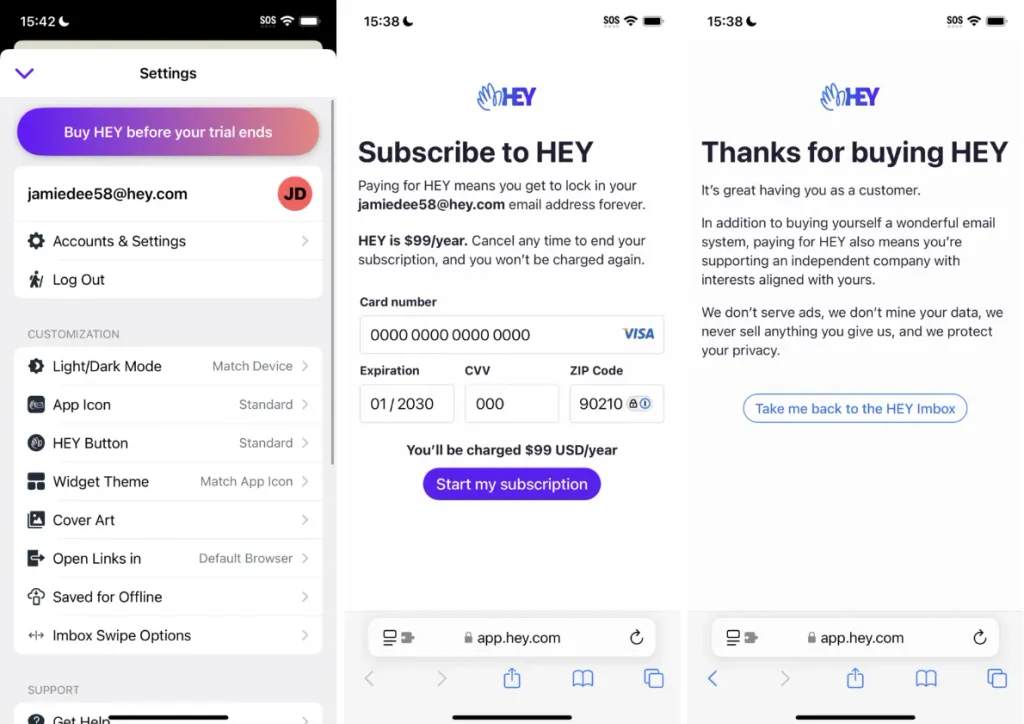
A: Actually that is not true, and HEY proves it. 37signals is a small company, and they added web purchasing to their app in May 2025 for the US market. Users can now sign up and pay for the annual subscription through a web checkout linked directly from the app. That was announced by co-owner and CTO David Heinemeier Hansson at launch. Now HEY has a 4.6 rating from about 4,300 reviews. You don't need Spotify's leverage with Apple to do this. You need a compliant flow and a good checkout.
So here is the early adopters, one year on:
| App | What changed | US App Store today |
|---|---|---|
|
Spotify |
Shows prices and links to web checkout for Premium; Apple approved this in May 2025 |
4.8 from 42M ratings, #1 in Music |
|
Fortnite |
Epic payments alongside Apple IAP, with rewards for paying through Epic |
4.6 from 349K ratings, #4 in Adventure |
|
Patreon |
Web checkout is the default for US iOS memberships |
4.9 from 577K ratings |
|
Amazon Kindle |
"Get Book" button opens Amazon's mobile web checkout |
4.9 from ~5.9M ratings |
|
HEY |
Paid subscriptions started from the app via web checkout |
4.6 from ~4.3K ratings |
Q: Will Apple shadow-ban my app if I add a link to my webstore?
A: I understand why it's one of the biggest fears. Nobody outside Apple can see the full ranking algorithm, and I won't pretend anyone can guarantee how every recommendation system behaves. But after more than a year, the evidence points one way. The apps that implemented web checkout first are still at or near the top of their categories, with millions of ratings between them. Also Apple's own search documentation says ranking is based on text relevance and user behaviour, including downloads, ratings and reviews. The share of payments going through IAP isn't on that list. Put those two facts together, and the fear of a shadow ban looks too overblown.
Q: Can Apple still reject an app for adding an external checkout button?
A: Not for the button itself, as long as it's compliant. A link to external purchasing on the US storefront is explicitly permitted by Guidelines 3.1.1(a) and 3.1.3, so adding one is not, on its own, a violation.
The rest of the guidelines still apply to your app. The US rules don't automatically extend to other countries, so the external checkout should only appear where it's allowed. And linking out is not the same as embedding a third-party payment system inside the app. The new rules let you add buttons and links that send users to a webstore outside the app. They do not mean you can add any third-party payment SDK directly inside your iOS app. For most developers, the simplest setup is: App → external link → browser-based webstore.
Q: So should developers switch off Apple IAP?
A: Almost never, and that would be the biggest mistake to make. Apple IAP converts very well because users trust it and already have their payment details stored with Apple. Your webstore has different strengths: you own the customer relationship, you control payment methods, and the economics can be much better. The smart move is to use both.
For games there's an extra reason. Guideline 3.1.3(b) lets consumables bought on another platform or website be used in the game, as long as those items are also available through IAP. So the safest architecture is D2C added next to IAP, not replacing it. The goal isn't to move 100% of payments to the web. It's to find the share of players who generate more net revenue through D2C without hurting conversion or player satisfaction.
Q: What does economics look like right now?
A: Exceptionally attractive. Apple's standard commission in the US on digital goods is still 30%, with 15% for qualifying developers and subscriptions. For US link-out purchases, though, Apple currently can't apply any extra fees until the district court approves an appropriate fee, which the Ninth Circuit made explicit. Apple has asked the court to allow 15% for standard apps, 10% for certain programs and subscription renewals, and 5% for Small Business Program apps. These rates are Apple’s proposals only and have not been approved by the court.
Assuming an illustrative 3.7% processing cost for a US-issued card and 1D3 service fee of 3%, here's what a developer keeps from $100 of gross sales:
| Payment route | Total platform and payment cost | Revenue from $100 |
|---|---|---|
|
Apple IAP, standard rate |
30% |
$70.00 |
|
Webstore + 1D3, if Apple gets its proposed 15% |
21.7% |
$78.30 |
|
Webstore + 1D3, today's 0% Apple commission |
6.7% |
$93.30 |
Real numbers will depend on payment methods, taxes, refunds, chargebacks and conversion. But even under Apple's proposed rate, a sale through the webstore is worth more, and today the gap is over $23 per $100. Moving even part of your volume can materially change net revenue.
Q: Can Apple start charging a commission on purchases made through my US webstore?
Linking out is allowed today, but the court case isn't finished yet. An appeals court confirmed that developers can send users to their own checkout, but said Apple may charge a limited fee on those sales. A lower court should now decide how big that fee can be. In August 2026, Apple asked for 5 - 15%. On top of that, the US Supreme Court has agreed to look at part of the dispute, and as of September 2026 that case is still open.So I'd separate two questions. Can you link US users to your webstore today? The answer is: Yes, Apple's guidelines explicitly allow it. Will Apple's commission on those purchases stay at 0% forever? That isn't yet settled, but the business case will work even if a new fee arrives.
Q: If you were an iOS developer starting today, what would you do?
A: In my role, I tend to trust numbers more than opinions, so I'd start step by step and let the data decide. Offer web checkout to part of your audience, keep IAP available, and make the web flow as fast and simple as possible. Then measure purchase conversion, ratings, retention and net LTV, and increase the share of D2C only if the numbers are good enough.
A year ago, developers were asking, "Are we allowed to do this?" With Spotify, Fortnite, Patreon, Amazon and HEY all doing it successfully, the better question now is, "Why haven't we done this yet?"